ID AND LOCATION
| Stanford #
| 37h |
| AG1980 #
| 37h |
| PM1960 #
| 252 b |
| Slab #
| IV-6 |
| Adjoins
| 37Am 37gi |
CONDITION
| Located
| true |
| Incised
| true |
| Surviving
| true |
| Subfragments
| 1 |
| Plaster Parts
| 0 |
| Back Surface
| smooth |
| Slab Edges
| 1 |
| Clamp Holes
| 0 |
| Tassello
| no |
TECHNICAL INFO
|
|
|
|
|
|
|
|
|
|
|
| ANALYSIS
|
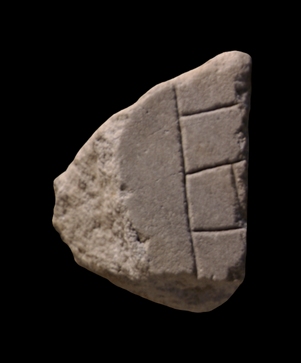
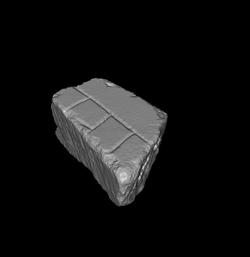
| Description The small fragment was part of a slab edge. A vertical street traverses the fragment. A row of regular rooms borders it on the right. On the left, a single column is visible.
Identification This fragment is the link that joins frs. 37gi
(see PM 1960, pl. 43). The qualities of slab IV-6 are determined by several securely positioned fragments, for example those that depict the Republican temples in the Largo Argentina. These qualities (the thickness and color of the marble, the ductus of the engraving, the surface deterioration, the veining direction, and sawing irregularities on the back [zigrinatura]) allowed E. Rodríguez-Almeida to place fragment group 37ghi in the lower right corner of slab IV-6 (Rodríguez-Almeida 1978-80a, pp. 95-96, fig. 3). The near join with and similar architecture of these fragments to fr. 37f
(depicting a section of the vicus Stabularius) which Rodríguez-Almeida had earlier located near the lower right corner of slab IV-6, solidified his location of fr. 37ghi. In 1983, Rodríguez-Almeida further cemented their location when he discovered that the clamp hole in fr. 37i fit a corresponding clamp hole on the wall of the aula. At the same time, he located fr. 602
in the lower left corner of the next slab over, slab IV-7; the architecture of this new fragment matched and joined exactly that of frs. 37ghi (Rodríguez-Almeida 1983a, pp. 87-90, fig. 1). This location identified the architecture depicted in frs. 39ghi as a section of the Campus Martius, between the vicus Stabularius and the Tiber river (see AG 1980, fig. 41). The street in this fragment, which continues in fr. 37gi, was identified as the vicus Aesculati, an ancient street that followed the bend of the river, as seen in fr. 37g (Rodríguez-Almeida 1978-80, p. 101; Rodríguez-Almeida 1983a, fig. 1).
Significance The architecture and marble characteristics of this and the joining fragments 37gi allowed Rodríguez-Almeida to locate them in slab IV-6, thus greatly enhancing our knowledge of this non-monumental area of the Campus Martius.
|
|
| HISTORY OF FRAGMENT |
| Like the majority of FUR fragments, this piece was discovered in 1562 in a garden behind the Church of Saints Cosmas and Damian. From here, it was transferred to the Palazzo Farnese and stored there. The fragment was later used as building material in a 17th c. Farnese construction, the Secret Garden, and it was rediscovered in 1888 or 1898 when the walls of the garden near the Via Giulia were demolished. Since then, it has been stored with the other known FUR fragments in various places: The storerooms of the Commissione Archeologica (1888/1898-1903), the Antiquarium Comunale (1924-1939), the Capitoline Museums (1939-1955), the Palazzo Braschi (1955-1998), and since 1998 in the Museo della Civiltà Romana in EUR under the auspices of the Sovraintendenza ai Beni Culturali del Comune di Roma (This fragments history corresponds to Iter E as summarized in PM 1960, p. 56). N.B. PM 1960 does not indicate the location of the fragment between 1903 and 1924.
Text by Tina Najbjerg
|
|
| KEYWORDS
|
| street, vicus |
|
 Prev
Prev